



Construction can be a rather complex procedure so a methodical approach towards problem solving is required. According to Romans a perfect structure has steeliness, resilience in time and provides comfort. In addition to those, nowadays, construction should meet contemporary design, cost-efficiency and sustainability. Our role is to supervise the process throughout all stages of construction in order to reassure that we work inside deadlines and meet all the criteria as described above. We love to deliver contemporary design buildings, made by modern materials that please our clients responding to his needs!


New building projects
During construction, we undertake its supervision, the selection of materials and the absolute implementation of the design in each construction phase, in order to ensure all of the above conditions. We also use all materials, mainly the newest ones (it depends of course on the design and the construction environment) and all modern construction methods in order to offer the most perfect result and achieve the absolute satisfaction of each employer according to their own needs.
We create modern structures, with modern building materials, with absolute respect for the residential environment, while also seeking energy savings for each user of the building structure.


Restoration – renovation
Reinforced structures
Old structures built before 1960, structures located in adverse environments (e.g. near the sea or in a mountain), or even newer ones where a mistake was made during the concreting work, need reinforcement. An old building that presents static problems must be treated as a whole. Following a visit from experienced technicians, a multifaceted approach to the problem is decided. The causes of corrosion are identified and interventions are decided. from waterproofing to the restoration of the supporting structure.
The main causes that can damage a building are seismic actions and moisture. How seismic actions stress and damage a building is known to more or less everyone. Moisture is a factor that can cause a lot of damage to the structural elements of a building as it penetrates and slowly corrodes the reinforced concrete.
For the proper restoration of a building, damage must be identified and then reinforcement proposals made. The reinforcement study must be carried out by a structural engineer with the necessary expertise and experience because an incorrect intervention can worsen the existing situation.
In general, our goal is to deliver the building safer to its users and extend its life.
We rely on invasive and non-invasive methods. Invasive methods include exposing the host organism and taking cores, while non-invasive methods include x-rays, percussion measurements, and others. After examining the results, a decision is made to strengthen the supporting organism with the most appropriate method at each time.
Ways to strengthen concrete buildings
- Cement injections – Resin injections
- Carbon fiber reinforcement
- Shotcrete (gunite) mantels
- Steel sheets
Ways to strengthen stone buildings
- Joints
- Gunite on stone
- Cement injections
- Resin injections


Facade Restoration
Any intervention requires particular attention from a specialized engineer and a qualified experienced construction team, supervised by our team to ensure the best possible facade restoration.
Several elements of a façade deteriorate faster than other parts of the building. There is an increased need for maintenance and repairs. The key to success is to pursue all possible sources and contributing factors that need to be addressed. Hands on and visual inspections (infrared imaging to identify thermal anomalies i.e. temperature variations that result in moisture compromised insulation, thermometers etc.) are performed to determine the problem. The latest repair techniques and the suitable types of materials are then used for the effective restoration of all items in need of repair.


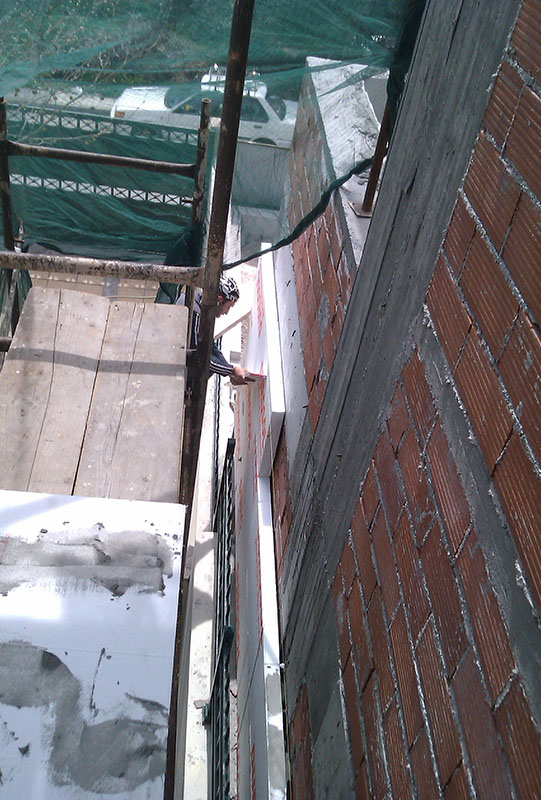

External thermal insulation systems
External Thermal Insulation (ETI) systems provide the energy efficiency your building requires while responding to increasingly rigorous thermal building standards and norms worldwide. It is applied on buildings for over 30 years, both in Europe and the United States. Whether embarking on an entirely new project or looking to renovate an existing building, energy efficient insulation should be a priority: if a building is well insulated it is energy-efficient, thus saving the owner money and it provides more uniform temperatures throughout the space, thus providing comfort. Essentially, the external thermal insulation is the placement of heat-insulating layers outside the building elements (eg brick-concrete or old plaster) followed by their coating with fine industrially produced coatings (instead of the conventional). If paired with the appropriate thermal roof insulation, the results in terms of thermal comfort and energy efficiency are truly unique!
Energy efficiency
The system provides a dramatic reduction of the thermal bridges in the structure of the building. Thermal bridges are the main culprit of thermal transfer across a building’s walls, drastically increasing heating and cooling costs. It retains heat and insulates against sound, as well as protecting buildings from moisture and expelling condensation. It also provides thermal comfort in winter and summer. By applying an external thermal insulations system, the cost for heating during winter and cooling during summer can be reduced by 45% to 60%. Finally the system provides the ability to efficiently insulate a building while also upgrading its exterior look and design with a range of colours and textures.
Other advantages
In addition to thermal insulation of existing buildings, the thermal facade contributes to their complete renovation in unlimited color choices, offering other benefits such as waterproofing of facades, avoiding cracks, mold and crevices, protecting the load-bearing structure, saving useful interior space.